As an Amazon Associate this site earns from qualifying purchases.
If your well water leaves brown-black stains in toilet tanks, on laundry, and around fixtures, you're almost certainly dealing with manganese — and you're probably wondering whether the Waterdrop G3 P600 vs APEC Essence ROES-PH75 matchup is the right way to fix it at the kitchen tap. The short answer in 2026 is that both RO membranes will reduce dissolved manganese below the EPA secondary standard of 0.05 mg/L, but they behave very differently when manganese arrives oxidized or above ~0.3 mg/L. The Waterdrop G3 P600 (tankless, 600 GPD, electric booster) tolerates well water fluctuations and self-flushes; the APEC ROES-PH75 (tank-based, 75 GPD, no electricity) is simpler and easier to feed from a dedicated iron/manganese pre-filter. The right pick depends on your raw Mn level, whether iron is along for the ride, and your household flow demand.
Why Manganese Is a Problem for Any RO System
Manganese in well water exists in two forms. Dissolved (Mn²⁺) is invisible and passes through sediment filters; oxidized (Mn⁴⁺) is the black-brown particulate that clogs pleats and coats the front face of an RO membrane. A reverse osmosis membrane rejects 95–99% of dissolved manganese on paper, but those numbers assume the membrane stays clean. Without proper pre-treatment, oxidized manganese forms a thin film on the membrane that drops production by 30–50% within months and can void warranties.
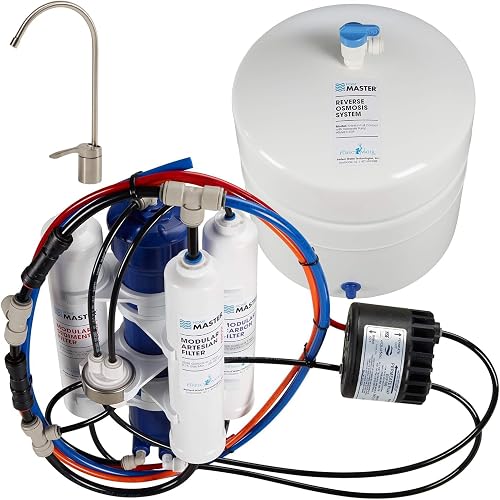
- Innovative RO System Design - Home Master Artesian Full Contact addresses common issues of canister and tankless systems with a unique, efficient design
- Enhanced Mineral Water - Features a patented remineralization system that adds essential minerals such as calcium and magnesium twice during the purification process, ensuring
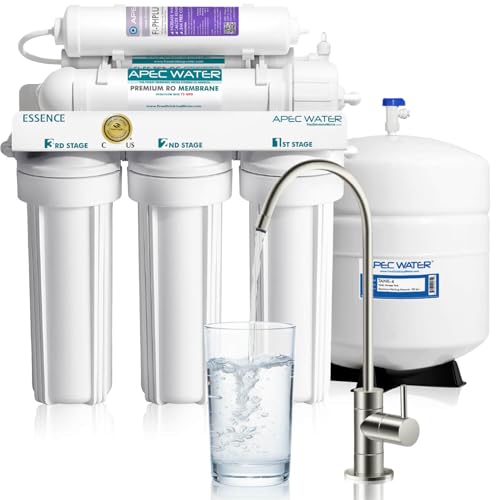
- Supreme quality – designed and engineered with only premium components to ensure high quality filtration and a durable reverse osmosis system for years
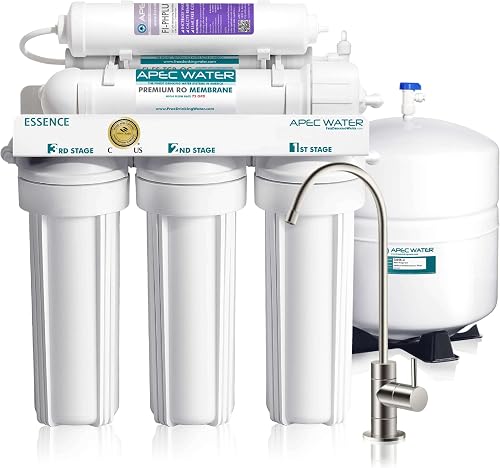
- This 75 GPD 6-stage system ROES-PH75 is guaranteed to remove up to 99% of impurities such as Chlorine, Taste, Odor, VOCs, as well as harmful Fluoride, Arsenic, Lead, Heavy Metals
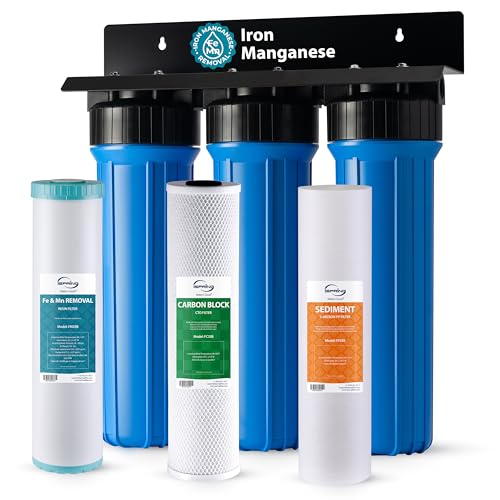
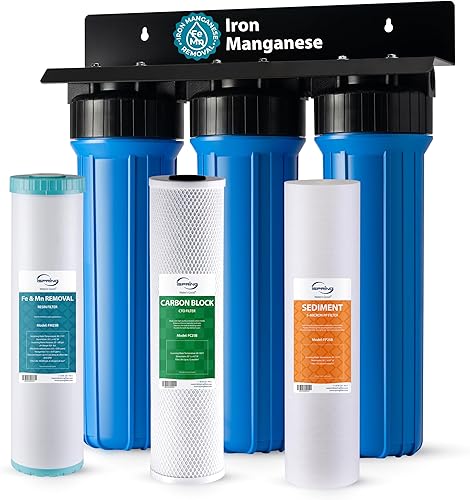
- Whole house water filter that protect your family and household appliance from iron, manganese and more: Our 3rd stage iron water filter (FM25B) is specially designed for iron and
- DIY installation and maintenance - refer to our manual and our helpful YouTube videos for easy DIY installation. With 1 in. NPT inlet / outlet and 20 in. x 4.5 in. water filter
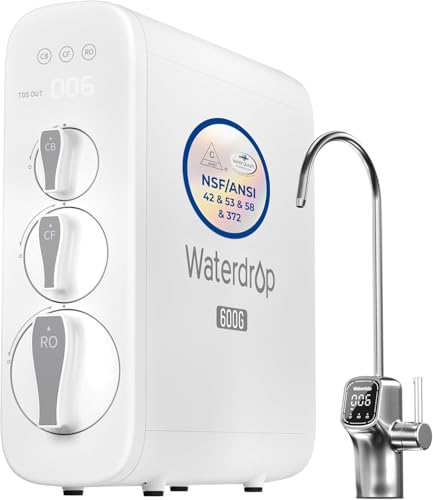
- [Trusted certifications]: Waterdrop G3P600 reverse osmosis system is certified against NSF/ANSI 58 for TDS reduction and NSF/ANSI 372 certified for lead-free material. Also it has
- [8-stage filtration]: Tested by official third-party laboratory (SGS), the reverse osmosis system can effectively reduce TDS, chromium, PFAS, radium, fluoride, arsenic salt, iron
Side-by-Side Specs
| Feature | Waterdrop G3 P600 | APEC Essence ROES-PH75 |
|---|---|---|
| Production rate | 600 GPD tankless | 75 GPD with 3.2-gal tank |
| Stages | 8-stage composite | 6-stage with alkaline post-filter |
| Pure-to-drain ratio | 2:1 | ~1:3 (more wastewater) |
| Power required | Yes (internal pump) | No (line pressure only) |
| NSF certifications | 42, 53, 58, 372 | 58, 372 |
| Membrane self-flush | Automatic | None |
| Footprint under sink | Compact, no tank | Bulky (manifold + tank) |
| Min. feed pressure | 14.5 psi (pump handles low) | 40–85 psi required |
| Ideal raw Mn level | ≤ 0.1 mg/L after pre-treat | ≤ 0.05 mg/L (no Fe) |
| Annual filter cost | ~$130 (CF + CB swap) | ~$60 (5 sediment/carbon) |
Before you compare the Waterdrop G3 P600 vs APEC Essence ROES-PH75 head-to-head, test your raw water. If Mn is above 0.3 mg/L, or if total iron is above 0.3 mg/L alongside it, an RO alone is the wrong tool — you need whole-house iron/manganese reduction first. The contaminants an RO actually removes guide covers the membrane's real limits in more detail.
How Each System Handles Manganese on Well Water
Waterdrop G3 P600 — better for fluctuating well pressure
The G3 P600's integrated booster pump is the single biggest advantage on a well. Most wells deliver 30–50 psi at the tap but drop sharply when the pressure tank cycles. The G3's pump maintains feed pressure to the membrane around 70–80 psi, which improves rejection of dissolved Mn and dramatically extends membrane life. The automatic flush cycle every few hours sweeps oxidized particulate off the membrane face before it can bond — this is the feature that matters most when trace manganese sneaks past a 5-micron sediment pre-filter. The TDS sensor on the smart faucet shows you immediately if rejection drops, so you'll catch fouling weeks before it becomes a problem.
Caveats: the G3 only reduces dissolved Mn. If your raw water shows visible black tint or rust streaks, the carbon block will load up in 4–6 months instead of 12, and you'll be replacing the $50 CF cartridge constantly. Pair it with a whole-house iron/manganese filter first — see the dedicated pick below.
Waterdrop G3P600 Reverse Osmosis System
APEC Essence ROES-PH75 — better when you've already solved iron/Mn upstream
The ROES-PH75 is a workhorse tank system that adds a calcite remineralization stage after the membrane, giving you a slightly alkaline finished water with a softer taste. For well-water users who have already installed a backwashing iron/manganese filter (or a manganese greensand unit), the APEC is the more economical, lower-maintenance choice. No power cord, no electronics to fail in a damp basement, and replacement filters are commodity-priced. The 75 GPD output sounds slow, but the 3.2-gallon pressurized tank means you get 0.5 GPM at the faucet — fine for drinking and cooking, slow for filling a stockpot.
The weakness on well water is the lack of a booster pump. If your line pressure drops below 40 psi, recovery plummets, drain-to-pure ratio gets ugly, and dissolved Mn rejection slips into the low 90s. Add an aftermarket booster (~$120) and the calculus changes. For an in-depth alternative comparison, see Home Master TMAFC-ERP vs APEC ROES-PH75.
The Pre-Filter Problem Nobody Talks About
Here is the part most reviews skip when discussing Waterdrop G3 P600 vs APEC Essence ROES-PH75 on well water: neither system is designed to oxidize and remove manganese. They both rely on whatever upstream filtration exists. If your test shows Mn above 0.05 mg/L, your single highest-leverage purchase is a whole-house manganese-reduction filter, installed before the RO. The RO then becomes a polishing step instead of a primary defense.
iSpring WGB32BM Whole House Iron & Manganese Filter
This is the pre-treatment we recommend for either RO above. The WGB32BM uses a 5-micron sediment stage, an iron/manganese reduction stage, and a CTO carbon block — sized for 1 inch ports and tested for ~100,000 gallons before media replacement. Installing it at the point-of-entry knocks raw Mn down by 75–95% before it ever reaches the under-sink RO, which doubles or triples your membrane life and protects the downstream carbon blocks. On wells with both iron and manganese (the typical pairing), the savings on RO cartridge swaps pay for the WGB32BM inside two years.
iSpring Whole House Water Filter System
Which Should You Buy?
Pick the Waterdrop G3 P600 if…
You have variable well pressure, you've already addressed (or will address) iron/Mn with a whole-house filter, you want high flow at the tap, and you don't mind a power cord under the sink. The 2:1 drain ratio also matters if your septic system is sensitive to extra wastewater. The smart TDS readout is a genuine diagnostic tool on well water — you'll know within a day if anything upstream fails.
Waterdrop G3P600 Reverse Osmosis System
Pick the APEC ROES-PH75 if…
You have stable, high line pressure (50+ psi), you've already installed pre-treatment for iron/Mn, you want the simplest possible system with no electronics, and you prefer the slight alkaline mineralization for taste. It's also the better pick if your kitchen has no GFCI outlet under the sink or if you're nervous about electronics in a humid basement install.
Honorable mention: Home Master TMAFC-ERP for the highest-Mn wells
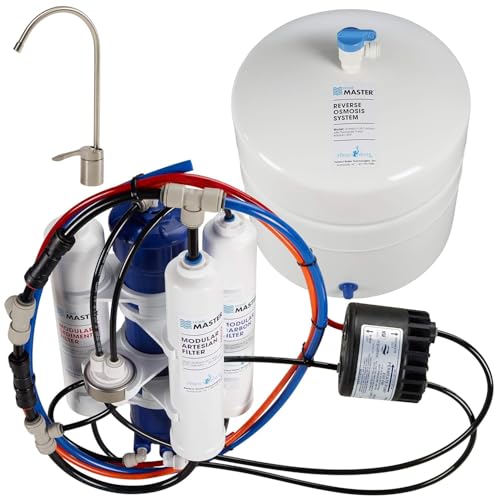
If your Mn levels are stubbornly above 0.1 mg/L even after a whole-house filter, the Home Master TMAFC-ERP deserves a look. Its larger 8.5-inch catalytic carbon stage chemically reduces residual oxidized manganese in a way standard CTO blocks can't, and the 1:1 wastewater ratio is the best in the segment. Pairs well with the same iSpring WGB32BM upstream.
Home Master TMAFC-ERP Artesian Full Contact Reverse Osmosis System
Installation Notes for Well Water
A few practical reminders before you install either of these in a well-fed home: confirm your incoming pH (manganese reduction media like greensand needs pH ≥ 6.8), install a 20-inch sediment cartridge upstream of any under-sink RO, use a clear pre-filter housing so you can see manganese loading visually, and sanitize the RO every 12 months — Mn-rich wells often carry iron bacteria that biofilm the tank. For a fuller walkthrough see our RO maintenance guide.
Frequently Asked Questions
Can reverse osmosis remove manganese from well water on its own?
RO membranes reject 95–98% of dissolved manganese, so on paper, yes. In practice, well water manganese is often partially oxidized by the time it reaches the membrane, and the particulate form fouls the membrane surface. Without an upstream sediment + iron/Mn reduction filter, expect membrane life to drop from 24 months to 4–6 months. Treat the RO as a polishing step, not a primary defense.
What manganese level is too high for an under-sink RO system?
Most manufacturers, including Waterdrop and APEC, spec their membranes for incoming Mn ≤ 0.05 mg/L. Above 0.1 mg/L you need pre-treatment; above 0.3 mg/L a backwashing greensand or catalytic carbon filter at the point of entry is mandatory. The EPA secondary maximum contaminant level is 0.05 mg/L — that's the staining threshold most homeowners notice.
Does the Waterdrop G3 P600 have a manganese-specific filter?
No. The G3 P600's eight stages include sediment, carbon block, and the RO membrane itself, all of which reduce dissolved manganese but none of which are optimized for oxidized Mn. Waterdrop's spec sheet assumes pre-treated municipal-grade water. On raw well water, plan on adding a whole-house Mn filter.
Will the APEC ROES-PH75 alkaline stage make manganese worse?
Raising pH after the membrane is fine — the manganese has already been removed at that point. The concern would be raising pH before the membrane, which can precipitate dissolved Mn into particulate form and accelerate fouling. The ROES-PH75 places its calcite stage last, post-membrane, so this isn't an issue.
How often should I change filters on a well-water RO?
Cut every manufacturer recommendation in half. Sediment and carbon stages that last 12 months on city water typically need replacement at 6 months on well water with trace manganese. RO membranes rated for 24 months realistically run 12–18 months. Watch the TDS reading on the G3's faucet, or install an inline TDS meter on the APEC, and replace the membrane when permeate TDS rises above 10% of feed TDS.
Can I run an RO system without a softener if I only have manganese, not hardness?
Yes. Softeners target calcium and magnesium hardness; they're not the right tool for manganese in isolation. A dedicated manganese filter (greensand, Pyrolox, or catalytic carbon) is the correct upstream device. If you have both hardness and Mn, you'll want both, with the Mn filter installed first.
Is a tankless RO like the G3 P600 actually better for well water?
Generally yes, for three reasons: the booster pump compensates for variable well pressure, the automatic membrane flush sweeps off Mn particulate before it can bond, and the lack of a stored tank eliminates the iron-bacteria biofilm risk that haunts tank systems on wells. The trade-off is dependence on electricity and higher cartridge cost. See our 2026 under-sink RO roundup for tankless alternatives in different price tiers.
Key Takeaways
- Choosing the right Waterdrop G3 P600 vs APEC Essence ROES-PH75 means matching the key features to your specific needs and budget
- Read real customer reviews and check the return policy before you commit
- Also covers: best RO for manganese well water
- Also covers: Waterdrop G3 P600 manganese removal review
- Also covers: APEC ROES-PH75 well water comparison
- Compare value across models — the priciest option is not always the best fit