As an Amazon Associate this site earns from qualifying purchases.
Discus keepers chase one number above all others: TDS. Wild-type and high-grade domestic discus thrive in ultra-soft, slightly acidic water that mimics the Amazon blackwater tributaries they evolved in - typically 50-100 ppm TDS, GH under 4 degrees, and pH 5.5 to 6.8. Municipal tap water, with its chlorine, chloramine, and dissolved minerals routinely running 200-500+ ppm, fights you at every water change. A reverse osmosis system for discus fish keeper tanks strips that tap down to near-zero TDS, giving you a clean blank slate you can remineralize with hobby-specific salts to hit your exact strain's target parameters.
Below are five RO units that genuinely fit discus husbandry - chosen for high GPD output (you will do a lot of water changes), NSF-grade membranes, and crucially, an absence of built-in alkaline remineralization post-filters that would defeat your soft-water goal.
Why discus need RO water - and what to avoid in a system
Discus are bioload-heavy fish that demand 25-50% water changes two to four times a week, especially in grow-out tanks holding juveniles you are trying to push to a 6-inch show specimen. If your tap runs 300 ppm TDS at pH 7.8 out of a chlorinated municipal line, you will chase your tail every water change. RO membranes reject 95-99% of dissolved solids, all chlorine and chloramine (with proper carbon prefilters), heavy metals like copper that are acutely toxic to fish, and the bulk of pesticides and pharmaceutical residues. You then re-mineralize with products like Seachem Equilibrium, Discus Buffer, or simple peat-buffered blackwater extracts to hit precisely the GH, KH, and pH your strain wants.
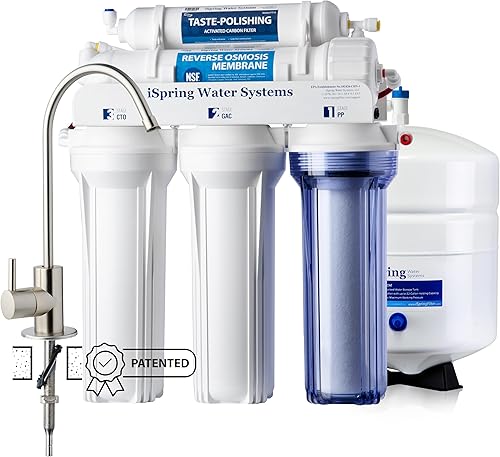
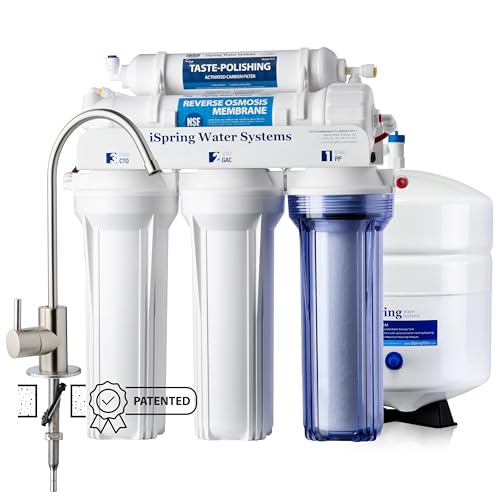
- EFFECTIVELY REDUCES CONTAMINANTS - The iSpring RO system delivers clean, pure, and great-tasting drinking water by removing up to 99% of over 1,000 harmful contaminants, including
- CERTIFIED TO NSF/ANSI 58 - Produced to strict American quality standards, this iSpring reverse osmosis system is NSF/ANSI 58 certified. For over 15 years, it has provided American
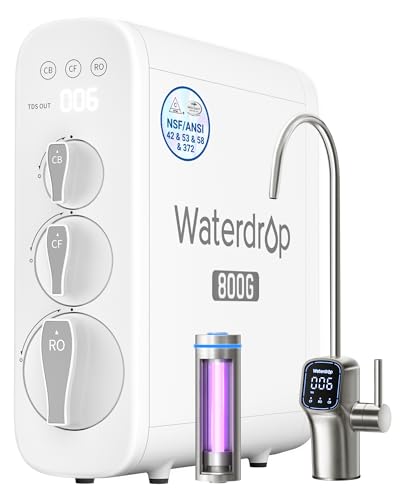
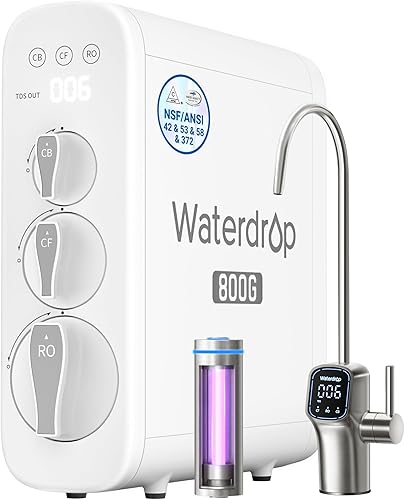
- [10-Stage filtration] Tested by official third-party laboratory (SGS), through 10-stage filtration, G3P800 can effectively reduce PFAS, fluoride, heavy metals like lead, chromium
- [800 GPD high capacity, 3:1 pure to drain ratio] The Waterdrop G3P800 reverse osmosis system offers a higher water capacity (800 gallons per day), thereby meeting demands of a big
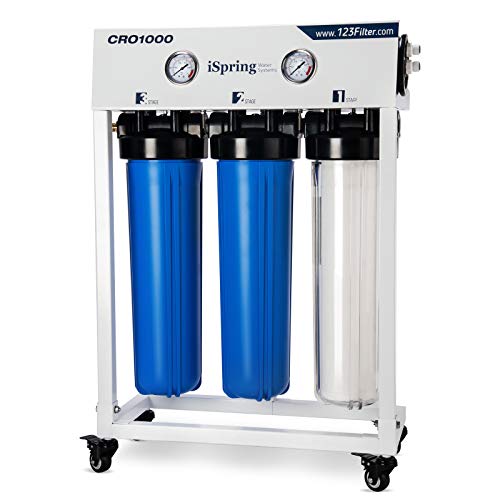
- HIGH-EFFICIENCY COMMERCIAL-SIZE RO MEMBRANE - Removes up to 99% of over 1,000 contaminants, including lead, chlorine, fluoride, arsenic, asbestos, calcium, sodium, and more. Its
- 4-STAGE WATER FILTRATION - Equipped with commercial-grade filters: a 20” x 4.5” PP Sediment Filter with a transparent housing for easy monitoring, two 20” x 4.5” Carbon Block
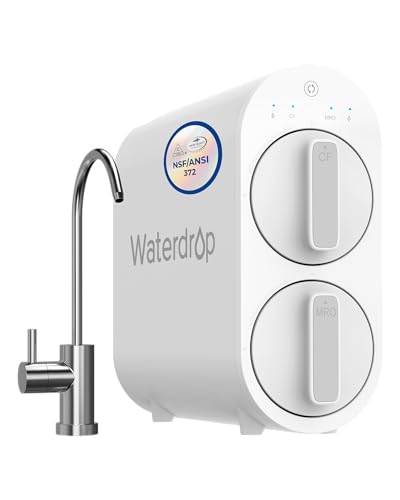
- [NSF/ANSI 372 Certified] 400 GPD & 1:1 low drain ratio & Tankless Design & Easy installation. Two filters are included in the package. Search "Waterdrop G2CF" and ''Waterdrop
- [7 Stage Filtration & effective filtration] The G2 system is certified by NSF/ANSI 372 for lead-free materials. The G2 RO System adopts a composite filter result in more effective
Quick comparison of the top picks
| Model | GPD Output | Stages | Style | Discus-friendly? |
|---|---|---|---|---|
| Waterdrop G3P800 | 800 | 8 | Tankless under-sink | Yes - no remin |
| iSpring CRO1000 | 1,000 | 4 | Tankless commercial | Yes - pure RO |
| Waterdrop G2 | 400 | 7 | Tankless under-sink | Yes - no remin |
| APEC ROES-50 | 50 | 5 | Tank-based | Yes - standard |
| iSpring RCC7 | 75 | 5 | Tank-based | Yes - no alkaline |
Here is the catch most hobbyist guides miss: you do not want an alkaline or remineralization RO system for discus. Those post-filters dose calcium and magnesium back into the permeate to raise pH and add taste - the opposite of your goal. Stick to standard 4-5 stage RO units (sediment + carbon block + RO membrane + post-carbon polish). You will add minerals yourself, in the buckets, in the doses your fish actually need.
A good reverse osmosis system for discus fish keeper applications also needs throughput. A single 150-gallon discus tank getting 40% changes three times a week is 180 gallons of RO weekly - a 50 GPD unit running 18 hours a day can technically keep up, but a 400-800 GPD tankless unit fills storage barrels in an afternoon and frees you to skip a day without falling behind. If you want a deeper primer on membrane chemistry before shopping, our how reverse osmosis works explainer covers the basics.
Top reverse osmosis system picks for discus keepers
Waterdrop G3P800 - best high-volume pick for multi-tank discus rooms
The G3P800 puts out 800 gallons per day through an 8-stage tankless design with a 3:1 pure-to-drain ratio, which is roughly twice as water-efficient as legacy 50 GPD units. For a serious discus keeper running a fishroom with two or three 75-gallon grow-outs and a 125-gallon display, this is the unit that lets you stop scheduling your life around the RO tank refilling. The membrane is NSF/ANSI 42, 53, 58, and 372 certified, which matters because cheaper unbranded membranes often fail to remove chloramine reliably - and chloramine residues kill discus fry first. There is no alkaline post-filter, so the output is the clean, low-TDS permeate you want to remineralize on your own terms.
Waterdrop G3P800 Reverse Osmosis System
iSpring CRO1000 - best for serious breeders and large fishrooms
If you are breeding discus commercially or running a fishroom with eight-plus tanks, the iSpring CRO1000 is the upgrade pick. It is a 4-stage tankless commercial unit rated at 1,000 GPD with upsized prefilter housings that take longer between cartridge changes - a real benefit when you are processing thousands of gallons a month. The simplified stage count (sediment, carbon block, RO membrane, post-carbon) is actually a feature for aquarists: fewer stages means less to maintain, no remineralization to remove, and a faster path from raw tap to soft permeate. Pair it with a 55-gallon food-grade storage barrel and a float switch for automated fishroom water changes.
iSpring CRO1000 4-Stage Tankless Commercial Reverse Osmosis Water
Waterdrop G2 - best mid-volume tankless for a single show tank
The Waterdrop G2 hits a sweet spot at 400 GPD with a 1:1 pure-to-drain ratio. For a single 75 to 125 gallon planted discus display getting twice-weekly water changes, the G2 will fill a 20-gallon Brute can in about an hour and a half. The 7-stage filtration leans on sediment and carbon polishing rather than mineral addition, so the permeate comes out at very low TDS - ideal for blackwater setups where you are dosing alder cones, catappa leaves, or peat to gently lower pH without fighting calcium loading. The tankless design also saves under-sink real estate if you are siting the RO unit in a laundry room or basement utility sink.
Waterdrop G2 Reverse Osmosis System
APEC Water ROES-50 - best budget pick for a single discus tank
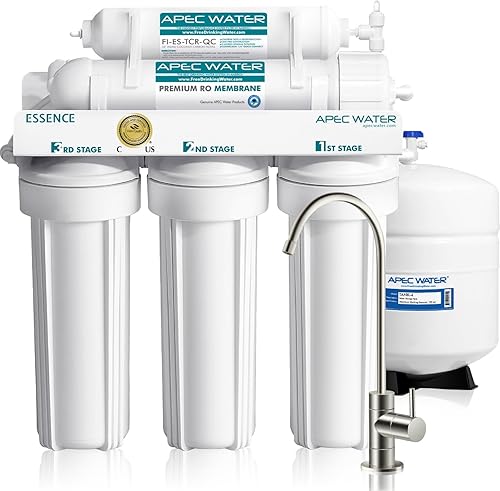
For keepers with one 55 to 75 gallon discus tank, the APEC ROES-50 remains the workhorse budget option. It is a classic tank-based 5-stage system (sediment + two carbon stages + RO membrane + post-carbon polish), NSF 372 and 58 certified, and importantly it does not include any alkaline or mineral post-filter. The output runs near-zero TDS on a healthy membrane, which is exactly what you want for re-mineralizing to discus parameters. The 4-gallon pressurized tank means you can draw a fresh bucket immediately without waiting for the membrane to produce on demand. Our full APEC ROES-50 review walks through long-term reliability and prefilter cadence.
APEC Water ROES-50 5-Stage Under Sink Reverse Osmosis System
iSpring RCC7 - best non-alkaline tank-based system for a planted discus aquarium
The iSpring RCC7 is the 5-stage, 75 GPD sibling of the more famous RCC7AK alkaline model - and for discus keepers, the plain RCC7 is the one you want. It skips the remineralization stage entirely, delivering low-TDS permeate that you can buffer however you like. The patented top-mounted faucet design simplifies cartridge swaps, and the higher 75 GPD membrane refills the tank noticeably faster than a 50 GPD unit when you are doing back-to-back water changes on multiple tanks. If you are deciding between this and the alkaline variant, our detailed iSpring RCC7 review covers the trade-offs.
iSpring RCC7, NSF Certified, High Capacity Under Sink 5-Stage Reverse
How to set up an RO unit for a discus fishroom
Three practical pointers that the product spec sheets will not tell you. First, plumb the RO output to a dedicated storage barrel, not the system's pressurized tank, if you are doing water changes larger than 5 gallons - the pressurized tanks are sized for drinking water, not 30-gallon refills. A 32 or 55 gallon food-grade Brute can with a lid and a small pump for delivery is the standard fishroom rig. Second, install a TDS meter inline on the permeate output so you can see immediately when the membrane is degrading; a healthy RO system should hold under 15 ppm on the output if your tap is under 400 ppm. Third, do not forget a heater in the storage barrel - dumping 65 F RO water into an 84 F discus tank will stress fish badly. A 300W titanium heater set to tank temperature is cheap insurance.
For ongoing membrane health, the basics in our RO maintenance guide apply: sediment and carbon prefilters every 6-12 months, membrane every 2-3 years depending on source water hardness, and a sanitization flush yearly.
Frequently Asked Questions
What TDS should RO water be for discus fish?
Permeate straight from a healthy RO membrane should read under 15 ppm TDS when your tap is under 400 ppm, and ideally under 10 ppm for a new system. You then remineralize back up to your target tank TDS - usually 80-150 ppm for domestic discus and 30-80 ppm for wild-caught fish. A reverse osmosis system for discus fish keeper use must be paired with a TDS meter so you can verify both the permeate and the final tank water.
Do I need an alkaline or remineralization RO system for discus?
No - in fact, avoid them. Built-in alkaline filters add calcium and magnesium that raise pH and GH, which is the opposite of what discus want. Choose a plain 4 or 5 stage RO and remineralize yourself with discus-specific products like Seachem Equilibrium, Discus Buffer, or Salty Shrimp GH/KH+.
How many gallons per day does a discus tank really need?
Rule of thumb: weekly water-change volume divided by 4 days of production = your minimum GPD requirement. A 125-gallon tank getting 40% changes twice weekly needs 100 gallons of RO per week, so a 50 GPD unit (which produces about 35-40 gallons in real-world conditions) is the practical floor. Multi-tank fishrooms should size up to 400-1000 GPD tankless units.
Will an RO system remove the chloramine that kills discus fry?
Yes, but only if the carbon prefilters are fresh. Chloramine breakthrough is the silent killer in older RO systems - replace carbon blocks every 6-12 months, and consider running a separate catalytic carbon stage if your municipality dosed chloramine heavily. Always test the permeate with a chlorine/chloramine test kit before using it for sensitive fry tanks.
Can I run RO water directly into a discus tank without remineralizing?
Not safely. Pure RO water has no buffering capacity, meaning pH can crash dramatically from CO2 and biological acids. Always add minerals back - at minimum a small dose of KH buffer (target 1-3 dKH) and GH salts (target 2-4 dGH for discus) before adding water to the tank.
What about a UV sterilizer or booster pump for low-pressure homes?
If your incoming water pressure is under 50 PSI (common in well systems or older homes), add a booster pump - units like the iSpring RCC7P with a built-in pump are options, or you can retrofit one. UV is more about disease prevention in the tank itself than RO treatment, though some keepers add an inline UV on the permeate line for fry tanks.
How long does an RO membrane last in heavy discus-keeper use?
A standard 50-75 GPD membrane treated to clean prefiltered water typically lasts 2-3 years before TDS rejection drops. Heavy-volume tankless 400-1000 GPD membranes often last 2 years under fishroom-level production. Track output TDS monthly - when it climbs above 10% of your tap TDS, it is time to swap the membrane.
Key Takeaways
- Choosing the right reverse osmosis system for discus fish keeper means matching the key features to your specific needs and budget
- Read real customer reviews and check the return policy before you commit
- Also covers: RO DI for discus tank
- Also covers: soft water RO for tropical fish
- Also covers: best RO for amazon biotope
- Compare value across models — the priciest option is not always the best fit