As an Amazon Associate this site earns from qualifying purchases.
To add uv sterilizer apec ultimate ro 90 owners only need three things: a 6–9 watt inline UV lamp rated for at least 0.5 GPM, a 110V outlet under the sink, and roughly 14 inches of clearance to mount the chamber vertically. The UV unit installs after the storage tank and before the dedicated faucet, so every drop you actually drink passes the lamp. Cut the 3/8” tubing between the tank tee and the faucet, splice in the UV inlet/outlet, plug it in, and you have a final post-membrane disinfection stage that kills any bacteria that may have colonized the tank during long idle periods.
Below is a complete walkthrough — parts list, exact placement, wiring, and whether you should retrofit your RO-90 or simply replace it with one of the UV-integrated systems on the market today.
Why add a UV sterilizer to the APEC Ultimate RO-90 at all?
The Ultimate RO-90 is a 90 GPD, five-stage system (sediment, two carbon blocks, membrane, post carbon). The RO membrane itself rejects 99%+ of bacteria, viruses, cysts, and dissolved solids, but the 4-gallon pressure tank downstream is a warm, dark, low-pressure reservoir. Over months of light use — vacations, second homes, or just a household that drinks more bottled water than tap — biofilm can form on the bladder, post-carbon block, and faucet tubing. None of that gets cleaned by simply changing the filters on schedule. A UV sterilizer mounted at the very end of the line gives you a true "point-of-use" kill step on the way to the glass.
- UPGRADED LED UV PROTECTION - Built-in LED UV stage provides an extra layer of protection with a mercury-free, maintenance-free design. Smart flow activation turns on only when
- TRUE LAYERED FILTRATION - Built with individually layered filter cartridges instead of compressed composite filters, delivering deeper filtration with visible, full-volume media
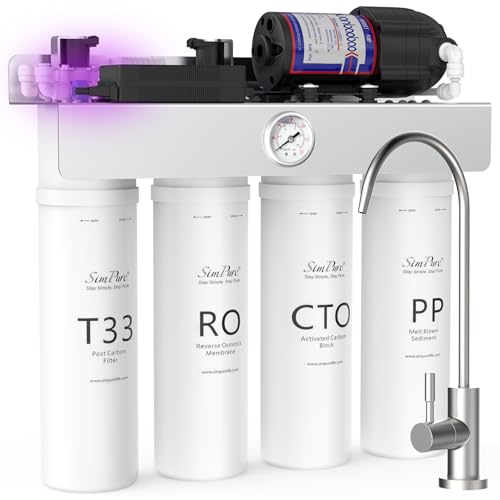
- TESTED BY SGS: Against the NSF/ANSI 58 Standard. The SimPure ROULP-3012-400-T1 has been independently tested by SGS, this ensures its exceptional quality and performance. It
- Filtered WATER NEAR 0 TDS: The water filter system utilizes exclusive technology to achieve near 0 TDS (Total Dissolved Solids), making it one of the most effective RO water
Should you retrofit or replace? UV-integrated RO systems worth comparing
Inline UV chambers run roughly $90–$180 plus the cost of replacement bulbs every 12 months and quartz sleeves every 2 years. If your RO-90 is more than five years old, three pre-built systems below are often cheaper over a five-year horizon than the retrofit path — and they ship with the UV already plumbed, gasketed, and warranted as one system.
| System | UV Location | GPD | Stages | Tank? | Best for |
|---|---|---|---|---|---|
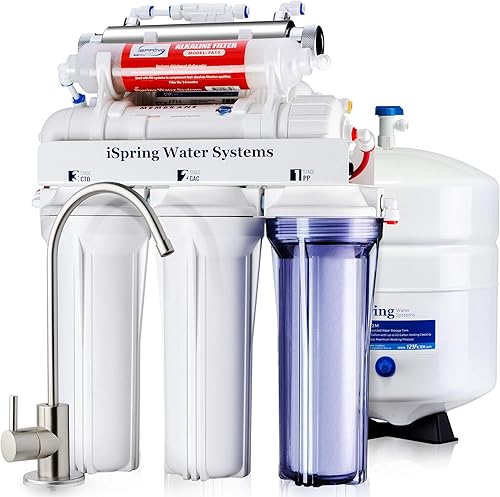
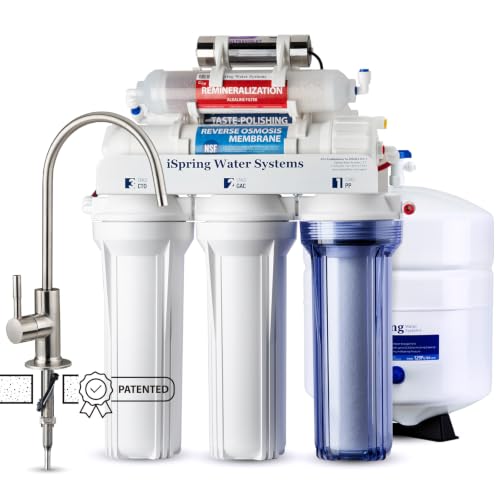
| iSpring RCC7AK-UV | Post-tank, pre-faucet | 75 | 7 (with alkaline) | Yes | Direct RO-90 replacement |
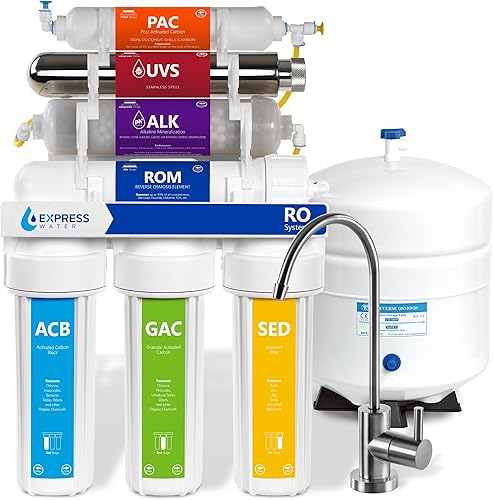
| Express Water ROALKUV10M | Post-tank, pre-faucet | 100 | 11 (alkaline+UV) | Yes | Highest stage count |
| SimPure T1-400UV | Inline tankless | 400 | 8 | No | No-tank cabinet space |
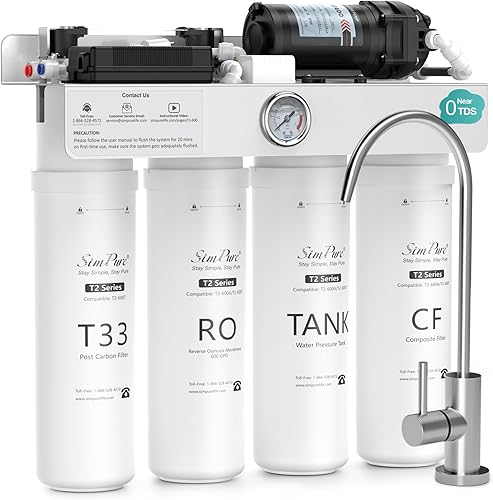
| SimPure T2-600T | Inline, built-in tank | 600 | 8 | Internal | Fast flow + UV |
This is exactly why several newer RO systems ship with UV baked in. If you're researching whether to add uv sterilizer apec ultimate ro 90 components or replace the whole rig, comparing both paths side by side is the only honest way to make the call. We'll do that in a minute.
Parts you need to retrofit the RO-90
- Inline UV chamber — a 6W (or 9W for heavier use) 304 stainless chamber rated 0.5–1.0 GPM. Viqua/Sterilight S1Q-PA, HQUA OWS-6, and Bluonics 6W under-sink models are the most common picks.
- Two 3/8” to 1/4” push-fit reducers if your UV inlet is 1/4” (the RO-90 tank line is 3/8”). If you bought the 1/4” tank upgrade kit, you may be fine with straight 1/4” unions.
- Two extra feet of food-grade tubing matching your line size.
- Tubing cutter — not scissors. A clean square cut is what makes push-fit fittings leak-proof.
- UV bulb sleeve cleaning cloth — microfiber, no fingerprints on the quartz.
- A standard 110V grounded outlet under the sink. If you don't have one, an electrician should add one; do not run an extension cord inside the cabinet.
Exact installation order on the RO-90
- Turn off the cold-water feed needle valve at the saddle, then open the dedicated faucet until the tank pressure bleeds to zero.
- Close the ball valve on top of the storage tank.
- Trace the tubing that leaves the tank ball valve. On a stock RO-90 it goes to the polishing post-carbon (the small horizontal in-line filter) and then to the faucet shank.
- Cut the tubing between the polishing post-carbon outlet and the faucet shank. That spot is critical — the post-carbon removes any taste artifacts, and the UV finishes the job. Putting UV before the polishing carbon means the carbon can shed micro-particles after the kill step, defeating the purpose.
- Insert the new line into the UV chamber inlet, then run the outlet to the faucet shank. Mark inlet/outlet on the chamber — most UVs are directional.
- Mount the chamber vertically with the lamp connector pointing up. This keeps any condensate off the wiring and lets the bulb seat into the quartz sleeve correctly.
- Open the tank valve slowly, open the feed valve, and run the faucet for 60 seconds before plugging in the lamp. This flushes any cutting debris past the new chamber.
- Plug in the UV ballast. The indicator should turn green/solid.
iSpring RCC7AK-UV — closest "drop-in upgrade" to the RO-90
If you're trying to add uv sterilizer apec ultimate ro 90 functionality but the existing system is already due for membrane replacement, the iSpring RCC7AK-UV is the least disruptive swap. The footprint, 3/8” feed, and saddle valve all match the RO-90's cutout, and the system uses the same dedicated faucet hole. You also get an alkaline remineralization cartridge that the stock RO-90 doesn't include. iSpring RCC7AK-UV.
Express Water ROALKUV10M — maximum stages plus UV
For households that want the broadest contaminant coverage — alkaline, UV, and active carbon polishing — the Express Water 11-stage with UV is the kitchen-sink option. The UV chamber sits in the polished-output stage just like a retrofit would, but it's factory wired with the ballast clipped to the bracket so there's no improvising under the sink. Express Water ROALKUV10M 11-Stage Alkaline Under Sink Reverse Osmosis.
SimPure T1-400UV — if you're ditching the tank too
The 4-gallon pressure tank on the RO-90 is the main reason UV is useful in the first place — it's where biofilm can grow. The SimPure T1-400UV eliminates that risk entirely with a tankless 400 GPD design, then adds the UV chamber on the output for a belt-and-suspenders kill step. Excellent for apartments and small cabinets where the RO-90's tank takes up half the under-sink space. SimPure T1-400UV Tankless Reverse Osmosis System with UV.
SimPure T2-600T — high flow with built-in UV
If you liked having a tank's worth of instant water but want UV without the retrofit, the T2-600T builds the pressure tank inside the housing and runs UV on the way out. 600 GPD also means less drain-water-to-pure ratio waste than the RO-90's 1:4. SimPure T2-600T Reverse Osmosis Water Filter System Near 0 TDS Water.
Common mistakes when retrofitting UV onto the RO-90
- Mounting the UV before the post-carbon. The post-carbon is the last filter before your glass; carbon fines downstream of the lamp re-contaminate the line.
- Using a UV chamber rated below 0.5 GPM. The RO-90 faucet draws fast from the tank. Underspec'd UV chambers don't deliver enough mJ/cm² of dose at that flow rate.
- Leaving the lamp unplugged "to save energy." UV lamps are designed to run continuously. Power cycling halves bulb life and leaves you with unsterilized water for the first minute after start-up.
- Skipping the quartz sleeve cleaning. At month six, scale and mineral haze on the sleeve cuts UV output by 30–40%. Wipe it with vinegar every bulb change.
- Forgetting to re-pressurize the tank. If you bled the tank for the install, check the Schrader valve pre-charge — 7 psi empty is the RO-90 spec.
Maintenance schedule after the retrofit
- UV bulb: 9,000 hours / about 12 months of continuous use. Mark the date on the ballast with a Sharpie.
- Quartz sleeve: Clean every 6 months, replace every 24 months.
- Membrane (RO-90 OEM): 2–3 years — unchanged.
- Pre-filters (sediment + carbon blocks): 6–12 months — unchanged.
- Post-carbon polishing filter: 12 months — unchanged.
For a deeper service interval guide, see our walkthrough on maintaining a reverse osmosis system, which covers tank sanitization — the step most owners skip when they retrofit UV.
Does the retrofit affect taste, pressure, or waste ratio?
UV is a no-chemical, no-additive process — it does not alter taste, smell, TDS, or hardness. Pressure drop across a 6W inline chamber is under 1 psi, so faucet flow at the sink stays the same. The RO-90's drain ratio is set by the membrane and flow restrictor upstream of the UV; adding the lamp does nothing to waste water. If anything tastes different after the retrofit, suspect the new tubing or fittings, not the UV.
How this compares to other APEC and iSpring options
If you want a broader read on platform choice before you commit, our APEC Top Tier vs iSpring RCC7AK comparison covers the housing, fittings, and faucet quality differences — which matters because the RCC7AK shares the same chassis as the RCC7AK-UV recommended above. For a sense of where the RO-90 sits in the broader APEC line, the APEC ROES-50 review documents the under-sink fitment specs that are nearly identical to the RO-90.
Frequently Asked Questions
Does the APEC Ultimate RO-90 come with a UV sterilizer?
No. The Ultimate RO-90 is a 5-stage system (sediment, carbon block, carbon block, RO membrane, post carbon). UV is not included from APEC on the RO-90 product line. APEC sells an add-on UV upgrade kit on some configurations, but most customers source a Viqua, HQUA, or Bluonics 6W inline lamp and install it themselves on the post-tank line.
Where exactly does the UV light go on an APEC RO-90?
After the storage tank and after the polishing post-carbon filter, but before the dedicated faucet shank. This sequence ensures water is taste-polished by the carbon, then sterilized by the UV, then delivered immediately to the glass without re-contamination from any downstream component.
What wattage UV bulb do I need for a 90 GPD RO?
A 6W lamp rated for 0.5 GPM is sufficient because the RO-90's faucet flow rarely exceeds that even from a fully-charged tank. If you have a larger 14-gallon upgraded tank or a booster pump, step up to a 9W lamp rated for 1.0 GPM to keep UV dose above 40 mJ/cm².
How long does an under-sink UV bulb last?
Roughly 9,000 hours, or about 12 months of continuous operation. Output drops gradually — by the one-year mark a bulb still glows blue but typically emits only 60–70% of its rated UV-C, which is below the kill threshold for E. coli. Replace annually even if it looks fine.
Can I run the UV only when I use the faucet?
You can install a flow switch that triggers the ballast on demand, but most household UVs are designed for continuous operation. Flow-switch installs add a startup delay of 30–60 seconds before the lamp reaches full output, meaning the first cup of water after a long idle period may not be fully sterilized. Continuous-on is the safer, simpler default for the RO-90 retrofit.
Is it cheaper to replace the RO-90 with a UV-integrated system?
Over five years, a retrofit costs roughly $90–$180 for the chamber, $30/year for bulbs, and $25 every two years for quartz sleeves — around $310–$400 total. A new iSpring RCC7AK-UV or Express Water ROALKUV10M lands in the same range and includes a new membrane, new pre-filters, alkaline remineralization, and a single manufacturer warranty. If your RO-90 is more than five years old, replacement usually wins on cost and simplicity.
Will UV remove TDS, fluoride, or PFAS from my water?
No. UV only inactivates living organisms (bacteria, viruses, cysts) by damaging their DNA. Dissolved solids, fluoride, lead, and PFAS are handled by the RO membrane and post-carbon stages upstream of the lamp. If you want broader contaminant reduction, the membrane is the component to upgrade, not the addition of UV.
Do I need a separate faucet for the UV-treated water?
No. The UV chamber sits inline with the existing RO-90 dedicated faucet — the same chrome lever you already have. The retrofit is invisible from above the counter; only the under-sink view changes.
Key Takeaways
- Choosing the right add uv sterilizer apec ultimate ro 90 means matching the key features to your specific needs and budget
- Read real customer reviews and check the return policy before you commit
- Also covers: apec ro 90 uv upgrade
- Also covers: uv light for ro system
- Also covers: apec uv add on
- Compare value across models — the priciest option is not always the best fit